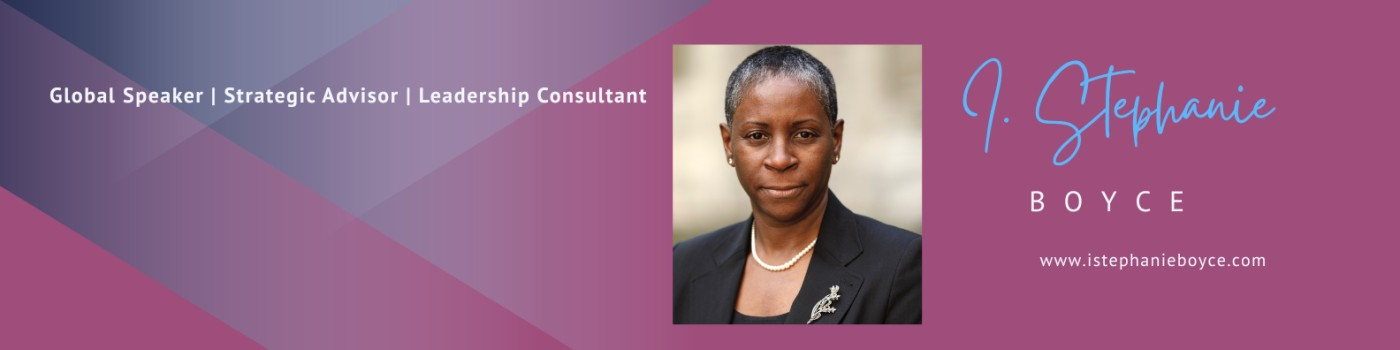

A landmark interview with Dr. I. Stephanie Boyce, former President of the Law Society of England and Wales, on ethics, technology, and the future of justice.

Intro: In times of deep polarisation and accelerated change, voices that seek to unite and build become essential. In this exclusive interview for Justice News247, conducted by Robert Williams, Editor-in-Chief, Dr. I. Stephanie Boyce — an architect of professional dialogue and an influential advocate for ethics, access to justice, and authentic leadership — shares her perspective on the most pressing challenges of our world: from the crisis of moral leadership to the ethical frontier of artificial intelligence and the fundamental role of justice in a healthy democracy.
Dr. I.Stephanie Boyce served as the 177th President of the Law Society of England and Wales (2021-2022), being the first person of colour and the second woman to hold the office. She was appointed a Commander of the Order of the British Empire (CBE) in 2026 for services to the legal profession, diversity, and access to justice. She is a sought-after speaker and writer on essential topics such as the future of law, the ethics of technology, and authentic leadership.
Robert Williams: Stephanie, you recently received a recognition that was perhaps long-awaited but fully deserved. The list of your awards and distinctions is long; please tell us if these are the ultimate reward of your existence, or do you find other deeper satisfactions?
I. Stephanie Boyce: 2026 has started off as it promises to go on, firstly, I have been appointed a Commander (CBE) of the Order of the British Empire in His Majesty The King’s New Year Honours, for services to the legal profession, to diversity, and to access to justice. The Honours list recognise people who have made significant achievements in public life and committed themselves to serving and helping Britain.
Secondly, I recently received the Orientem Solem Award. Now in its fifth year, the award is presented to those who have broken barriers and contributed meaningfully to social discourse and societal thought. I am humbled to be counted among previous recipients, which have included two former Irish Presidents, Mary Robinson and Mary McAleese, a former Lord Chief Justice, Justice Frank Clarke and a former President of the UK Supreme Court, Brenda Hale, Baroness Hale of Richmond and now me.
It was also a privilege to share the occasion with Bob Geldof, KBE, who was awarded the Manus in Manu Award for his extraordinary humanitarian work. Many will remember Bob as the lead singer of the Boomtown Rats and Live Aid.
These recent awards and honour add to my growing list of recognition for the work I have done and do. It is always nice to be recognised with an award, but ultimately the satisfaction comes from change, positive change, change that sees our profession, the legal profession more accessible, where there is equality of opportunity and in a world that allows you to go as far as your talent will take you.
Robert Williams: Stephanie, the recent years have been extremely complex and volatile; is the voice of a professional leader like yourself currently a source of innovation, or are professional elites being ignored?
I. Stephanie Boyce: For me, leadership rests on a number of core values:
- Authenticity, being honest about what we know and what we do not know, and about how our own experiences shape our sense of risk and fairness.
- Accountability, accepting that decisions we make affect people’s lives, and that someone must take responsibility when things go wrong.
- Integrity, aligning words, decisions and deeds, resisting the temptation to chase short term efficiency at the expense of long‑term trust.
- Empathy, the ability to respond with fairness, respect, and compassion.
- Respect, Respect for differences. We may not share the same beliefs, identities or language but yet we respect those differences.
- Morality, living your values and acting on your principles, even when uncomfortable, difficult, or inconvenient.
Much of the above is in short supply or even absent in today’s global leadership, resulting in a vacuum of polarisation and deep division. Leadership is about stewardship, emerging voices willing to lead with moral courage and principled values that doesn’t denigrate, discriminate or dominate but with principles and values that recognises the value of everyone even when we might not agree, but we can disagree well. That to me is leadership, the ability to unite not to divide.
Robert Williams: There is a concern among legal professional leaders worldwide—you, as an advocate for access to justice, equity, AI regulation, legal education, and the legal profession… do you see the current measures as being argumentatively strong enough, or are we witnessing a weakening and a loss of ground for these needs?
I.Stephanie Boyce: During my presidency of the Law Society, I led the profession through extraordinary global disruption: a pandemic, economic instability, geopolitical uncertainty, and rapid technological acceleration. Leadership in such moments is not about having all the answers. It is about asking the right questions early enough, and being willing to actively listen.
Technology has always shaped professions; that is not new. What is new is the speed, scale and opacity of the systems we are now deploying. AI does not simply support decision making; in many cases, it is beginning to replace it. That shift raises fundamental questions about accountability, trust and power, and about how we as humans learn, develop and interact with each other.
Since leaving office, I have spent significant time speaking about technology, not because I am anti‑innovation, but precisely because I believe innovation without ethics, governance and human oversight is not progress. It is risk disguised as efficiency.
I have spoken of the need to ensure that there is adequate guardrails in place. AI is likely to be one of the most transformative technologies of a generation, with the potential to add tens of billions to national output each year. Yet only a minority of businesses currently report using it. A large proportion of executives say they are adopting AI agents, even as many admit uncertainty about how to ensure these tools truly create value rather than just noise. At the same time, reports show that a significant share of UK businesses have already encountered some form of AI‑related fraud. The risks are not theoretical.
The lesson is straightforward: we need clearer guardrails in law and regulation, but we also need leaders willing to exercise judgement ahead of regulation, not merely in response to scandal.
Robert Williams: Stephanie, there are prestigious organizations in the world, such as one dear to you, The Women in Law Initiative, where you have spoken about leadership; where do these “elitisms” dilute or stop when facing the decision-makers who should be setting things right?
I. Stephanie Boyce: I am not sure I understand the question, but simply put, elitism should stop the moment leadership becomes performance rather than responsibility. Spaces like Women in Law Initiative matter because they amplify voices, but not if no one is listening. The real test is whether decision makers listen, act, and share power, not just platforms. Leadership that doesn’t translate influence into change is simply privilege talking to itself.
Robert Williams: Looking at different countries and systems, do you believe that justice should be shepherded only by the legal professions to avoid crises, or is something failing at an ideological and human quality level?
I. Stephanie Boyce: An issue that is galvanising the legal profession and members of the public in the United Kingdom and that is the recommendation to have juryless trials in certain cases, the most serious ‘indictable only’ cases, such as robbery, rape and the most serious violent assaults, will continue to be eligible for a jury trial. All other offences where a likely sentence is three years or less, are proposed to be moved away from juries and into new “Swift Courts” heard by a judge alone.
When I talk about law, I do not mean only statutes and precedents. I mean the lived reality of justice: whether people can enforce their rights, whether they are heard by their peers, and whether they can trust the institutions that decide their fate. In England and Wales, few institutions embody that promise more tangibly than the jury trial.
A jury is more than a procedural mechanism. It is a democratic safeguard, the principle that serious accusations against an individual will be tested not only by the state, but by a cross‑section of the public. It is an expression of the idea that justice is not something done to people, but with them. While the legal profession has not always found favour with the public the public are squarely behind the legal profession and others who oppose these proposals. The law should never be something done to people, the law is an instrument of change.
Robert Williams: Stephanie, as current data shows, how do you think legal education—and not only—would complete the current or future generations? Is this an answer and a form of resistance to the changes being foreseen?
I. Stephanie Boyce: I have long been a strong proponent of law being taught in all schools from as young an age as possible, students should know their rights. After all, legal rights mean absolutely nothing, if you don’t know what your rights are and you don’t even know when those rights are being taken away. We need the public to be better engaged in respect of our fourth emergency service, the justice system. Far too often people come to the justice system at a point of trauma, a criminal charge, divorce, custody battle, a boundary dispute, at this point it is too late to learn about the justice system when you are already traumatised but by teaching the public about their rights, and how to enforce those rights, we better equip them to respond when those same rights are infringed and under threat.
Robert Williams: An important chapter consists of your message regarding AI legislation and how the legal and administrative professions, and humanity in general, relate to it. Is there a need for education, or simply for regulation, which clearly will not be able to answer all cases?
I.Stephanie Boyce: We need laws and standards that keep pace with rapid AI development, specifying where flexibility is appropriate and where “red lines” must never be crossed if we are to maintain safety and public trust. But no legal framework, however well designed, will never fully substitute for human courage and human judgement.
People sometimes ask why, after a demanding presidency, I continue to speak, write and engage on these issues. The answer is simple. Because technology is shaping power. Because power without accountability is dangerous. And because the decisions being made now will shape the systems future generations inherit.
If we get this right, technology can widen opportunity, improve outcomes and strengthen trust. If we get it wrong, it will deepen inequality, concentrate power and erode the very institutions we rely on to protect us.
When future generations look back at this moment, will they say we used technology wisely, or that we surrendered responsibility to it too easily? That is not a technical question. It is a leadership one.
Robert Williams: Stephanie, the final question finds us looking both retrospectively and at the present, but I ask you as a source of will, wisdom, and patience regarding the way things are, as you so sublimely described: “Every door is open if you PUSH: Persevere Until Something Happens”. Are all the issues listed in the questions above a final battle for humanity, for everything you militate for and continue to do so masterfully?
I.Stephanie Boyce: No, we must continue to PUSH. The world is at an inflection point, the rules based order we grew up with is no more and so we must adjust to this new world with strength and clarity that lifts people up, leaves no one behind. Where the riches of equality are evenly spread.
Robert Williams: Stephanie, thank you. You honor us every time with your presence and your work. We hope that the values and principles you have enumerated—both in your interviews and through your presence—will be even more deeply understood. Justice News247 stands with you and shares your vision.
By
Robert Williams
Editor in Chief

Global Speaker | Strategic Advisor | Governance, Ethics & Inclusive Leadership Consultant | Helping Organisations Build Trust, Strengthen Culture & Lead Responsibly | Former President, Law Society of England and Wales.
If you’d like me to speak at your event, please get in touch,
email: stephanie@istephanieboyce.com.
Discover more from Justice News247
Subscribe to get the latest posts sent to your email.